
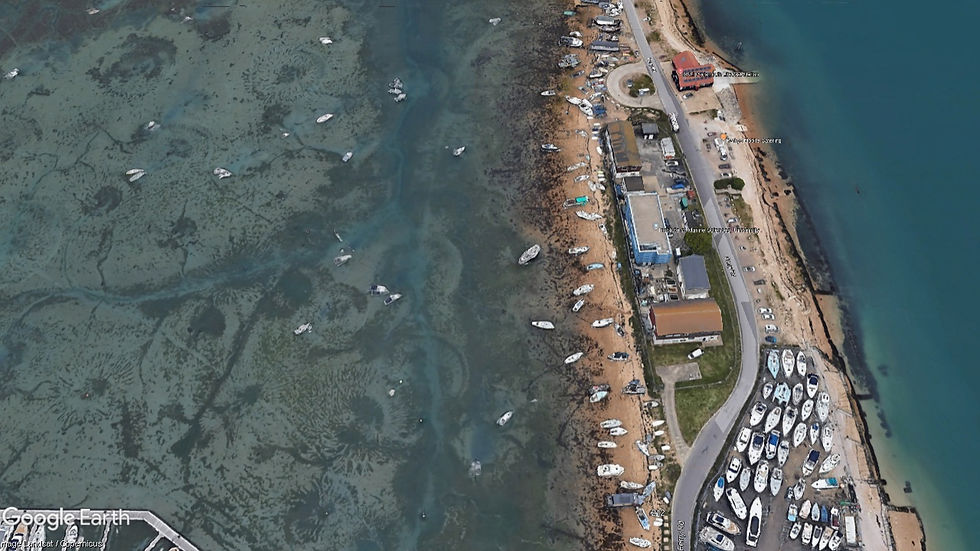
Langston Harbour AMS
Langston Harbour, Solent
Design, Supply and Installation of AMS at Eastney Lake, Langston Harbour
Background
In 2025, Langston Harbour Board (LHB) cleared its Eastney Lake site from derelict vessels as part of it environmental responsibility. To further increase the positive environmental impact of this, LHB also elected to install Advanced Mooring Systems to avoid vessels being abandoned on the beach again. LHB decided to use AMS as it would potentially reduce the scour of the seabed by up to 43%.
LHB released a tender in June 2025 for the design, install and supply of 20 AMS at their Eastney Lake site.
Objectives
The objective of the project was to design, procure and installation of 20 fore and aft AMS at the Eastney Lake site. The moorings must be capable of servicing vessels up to 30’ in length and 5t in weight and ensure a reduction in mooring failures.
The project specific objectives were then defined as:
Improve inshore fisheries with the reduction of derelict wrecks
Reduce mooring failures
Improve the safety of Eastney Lake and increase revenue
Reduce current levels of scour from moorings and wrecks
Increase the mooring presence of vessels to reduce the space for derelict vessels to be left
Satisfy the on-going conservancy duty requested by the LHB Advisory Committee
Methodology
ABC Subsea approached this project using their three-stage process.
FEED: A Front End Engineering Design process was undertaken to ensure the project needs were robustly designed to be executed to the agreed scope, on schedule and within the agreed budget.
Procure and Install: In-house and approved suppliers were used to ensure all equipment would operate to the optimum standards. This equipment was then installed by ABCS’s experienced team allowing for rigid quality management system.
Findings & Analysis
The site survey revealed that HSAs were suitable and could be installed in the intertidal sediment. Holding capacity was dependent on seabed stiffness and was determined using the maximum torque achieved, with final torque readings used to calculate the safe working loads. It was also determined that 2 m HSA extensions would not be required to meet the holding requirements. Due to the intertidal location, the HSAs could be installed by a two‑person team without the need for marine equipment, reducing installation costs.
This allowed the layout of the 40 mooring points to be plotted using GIS and a UXO survey to be undertaken. The results of the UXO survey indicated that one mooring point was located in an area where an “unknown” was detected. To reduce the risk profile during the installation phase, it was decided to relocate two mooring points to an area with no identified “unknowns”.
Mooring load calculations indicated a required capacity of approximately 1.5 t, including a safety factor of 1.5. Due to the mooring configuration operating in an intertidal environment, the solution was designed to minimise impact on the seabed. Given the low calculated loading, an all‑rope riser would be utilised to help reduce scouring. A flat‑bottomed buoy was also incorporated into the design to further reduce seabed impact. This would minimise buoy movement on the seabed at low water levels and when dried out, thereby reducing the potential radius of damage.
Proposed Solution
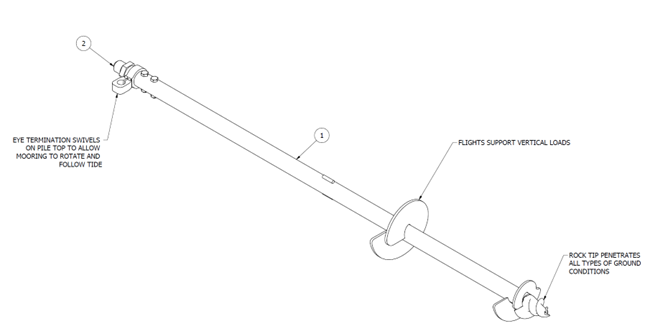
The FEED output allowed ABCS to use their standard 60R Helical screw piles for the anchors. These would provide an approx. load capacity of up to 48 kN when installed using a handheld torque unit. The layout would be in a grid pattern with one mooring being displaced due to the findings of the UXO survey.
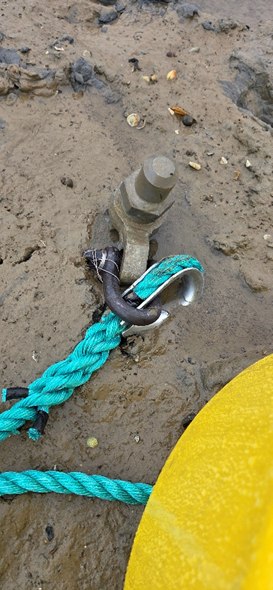
The mooring riser was constructed of a single length of 20mm PolySteel with a nylon or galvanised thimble spliced into each end for the shackle connections. This would reduce unnecessary components that could cause damage to the seabed and be an additional maintenance cost. PolySteel has a specific gravity of 0.91 meaning it would float, allowing it to maximise its time off the seabed.


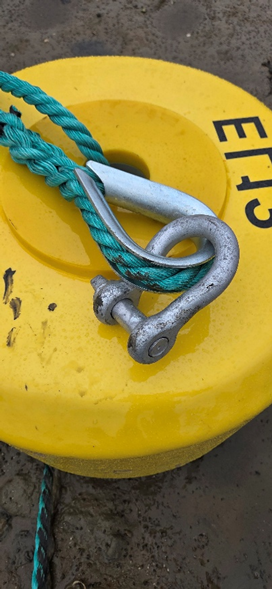
AIS SBS4 buoys would be used which are 578mm diameter, weight 9kgs and have a flat bottom. The riser would pass through the buoy and be secured using a thimble and shackle that would allow a mooring rope or strop to be connected to.
Implementation
The moorings were installed over three days using the following equipment:
ABC Autoguide Hand held torque head
ABCS Dive Team (for working on soft sediment)
The mooring point grid was marked out manually as per the design layout, which enabled easy positioning of the HSA’s. Mudders were used to allow ease of movement over the softer sections of seabed and faciliated easier handling of the torque head.


The mooring configurations were constructed on the beach and then dragged into place to be connected to the HSA terminations.
Suppliers
ABCS used the following suppliers for the equipment installed:
Equipment | Supplier |
Helical Screw Anchors | ABC Autoguide |
PolySteel Galvanised Thimbles | Southern Ropes |
Nylon Thimbles | S3i Group |
Shackles | BW Chains and Moorings |
Buoys | AIS Marine Ltd |
Labour | Island Divers |
Conclusion
The Eastney Lake Advanced Mooring System project successfully met Langstone Harbour Board’s objectives of improving conservancy, navigational safety, and long-term mooring resilience. Through the use of the FEED process, followed by efficient procurement and installation, ABCS delivered a robust and low-impact mooring solution tailored to the intertidal conditions of the site.
The site survey confirmed the suitability of helical screw anchors within the existing sediment, allowing installation without marine plant and significantly reducing costs and environmental disturbance. Careful consideration of UXO survey findings led to minor layout adjustments, further reducing installation risk while maintaining the required mooring capacity. The final mooring design, incorporating floating PolySteel risers and flat-bottomed buoys, was optimised to minimise seabed interaction, reduce scour, and limit seabed damage during low-water conditions.
The selected AMS configuration provides sufficient capacity to safely service vessels up to 30 feet and 5 tonnes, with appropriate safety factors applied. The simplified mooring arrangement also reduces maintenance requirements and improves long-term reliability, directly addressing historic mooring failure issues and reducing the potential for future derelict vessels within Eastney Lake.
Overall, the project demonstrates a sustainable, cost-effective, and environmentally responsible approach to mooring infrastructure. The installation of the AMS supports LHB’s conservancy duties, enhances the safety and usability of the site, and delivers measurable environmental benefits, ensuring Eastney Lake remains a well-managed and economically viable harbour area into the future.
This case study is the property of ABCS and should not be used or re-produced without consent.
Power in Numbers
20
Moorings installed
3
Project Days
Project Gallery


